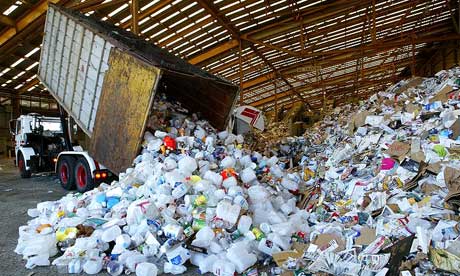
In the UK, local councils have been forced by national government to recycle more waste, both directly and indirectly via a landfill tax.
But does anyone know just how effectively this will reduce our carbon footprint?
That is not a rhetorical question readers. If you know or suspect an approximation of an answer, or a partial one, please post a comment.
Some of the questions that need answering include the energy consumption involved in collecting and sorting recyclable waste and the overall energy savings in the re-manufacture of the materials, which may involve shipping materials half way around the globe. And on that last point, how much of the stuff simply ends up in a third-world landfill?
Some of the questions that need answering include the energy consumption involved in collecting and sorting recyclable waste and the overall energy savings in the re-manufacture of the materials, which may involve shipping materials half way around the globe. And on that last point, how much of the stuff simply ends up in a third-world landfill?


5 comments:
On some items im sure that the amount of energy, hence carbon fp to recycle the good is less than that to manufacture it new. ie, you save carbon when recycling.
However, on others the processes to remove the dyes, paints etc i would expect quite a complicated process...hence energy consumption...hence carbon.
I think its very PC to say we are recycling, but are we actually emitting less CO2?
Unfortunately I don't know the answer either, except that for aluminum, it's so efficient that people actually make good money doing it. However, I would like to just point out that CO2 emissions aren't the only thing recycling affects. It also reduces landfill waste, especially of less-biodegradable products like plastic and glass, as well as reducing other types of pollution, and environmental harm involved in producing new materials.
Of course, there are similar costs for recycling. But, with glass recycling, for instance, it doesn't require any further mining of the irreplaceable environment.
Here's a little info on glass recycling: http://en.wikipedia.org/wiki/Glass_recycling
A useful comment I read a few years ago is that thoroughly cleaning plastic and glass items before sending them off to recycling dramatically increases the net amount of energy spent on recycling these items. The process of remanufacturing itself has huge energy requirments (rinsing, grinding, melting, extruding etc). Better to let the more efficient cleaning facilities clean the items "en masse" rather than creating a larger carbon footprint by pre-cleaning these items.
I just wondered how you feel about incineration.
West Norfolk is at war with Norfolk County Council, following a referendum where an overwhelming majority said they do not want an Incinerator in West Norfolk
County Council still pushes ahead.
On Recycling West Norfolk was one of the First areas to introduce it.
But has fallen behind due to the type of material the Authority is prepare to recycle.
Ie lots of plastic containers are not the correct grade plastic. Meat dishes, yokurt pots for example
Ian,
A well-designed and properly managed incinerator can sometimes be the best option but it is an issue that tends to breed 'NIMBYs'.
Currently there are differences in what local councils will accept for recycling - in my area yoghurt pots and meat trays are specifically mentioned on the "acceptable" list. Another issue, touched on by a previous comment, is what happens to the the material collected for recycling.
Post a Comment