When compared to large industries, the small oven cleaning companies are not major polluters but many use highly caustic formulations based on sodium hydroxide. However there are now effective, far more eco-friendly alternatives available. Produced by Solution Cornwall Ltd. in the United Kingdom, they are also far safer for the cleaning operative and anyone else in the work area, which is often someones home.
As with any cleaning operation what is used to produce the clean is just part of the story. Correct procedures have a great part to play in getting the best result with maximum efficiency and with minimal environmental impact. This is where the highest standards of training contribute to produce the ultimate professional oven cleaner.
Paul Pantony, an experienced and highly respected lead figure in this segment of the cleaning industry is currently planning an upgrade to his training facilities so that his hands-on training workshop offers a wide range of oven types on which both novice and experienced cleaners can learn or hone their skills under his tutelage.
In order to be able to offer the best facility, Paul is currently raising additional capital via http://www.crowdfunder.co.uk/oven-cleaning-training-workshop and I wish him swift success in this.
Tuesday, 16 May 2017


Thursday, 13 January 2011
Human body heat heats nearby building
In Stockholm (Sweden) the body heat generated by commuters in the busy Central Station is being used to heat a nearby office block.
The human body typically generates 100 watts of heat. Heat exchangers located in the stations ventilation system convert this heat into hot water, which is then pumped to the office building, providing it with environmentally friendly and cost effective heating.
It is estimated that the process can reduce the office buildings energy costs by up to 25%.
The human body typically generates 100 watts of heat. Heat exchangers located in the stations ventilation system convert this heat into hot water, which is then pumped to the office building, providing it with environmentally friendly and cost effective heating.
It is estimated that the process can reduce the office buildings energy costs by up to 25%.
To see a video of the story, with more detail, visit:
Monday, 7 June 2010
This blog is carbon neutral!

A group of organisations in Germany and North America have arranged to plant a tree on behalf of this blog.
Consequently both myself and my readers can be assured that the existence of the blog is at least carbon neutral for many years to come.
The locations of the plantings under this scheme can be viewed at:
Thursday, 29 April 2010
Parkland built on rubbish
It's not the first time this has been done but this is the largest project of its' kind
What is a first is Fusion 8, the latest offering for green cleaning now available from World of Clean
What is a first is Fusion 8, the latest offering for green cleaning now available from World of Clean
Saturday, 18 July 2009
No flight of fancy
The substitution of hydrogen fuel cells for hydrocarbon fuels or their vegetable-oil based substitutes, promises a cleaner environment with greater ecological gains. However, development and implementation is being held back by the problem of storing the dangerous gas safely and efficiently. One ingenious solution is to store the gas in a 'sponge' of carbonized keratin - the protein that forms skin, hair and ......bird feathers.

A team at University of Delaware have discovered that the protein keratin, (in the form of chicken feathers) developed interesting properties when it's heated. What happens is that the keratin creates very strong cross-links when it's carbonized, and the feather fibres become super-porous, dramatically increasing their total surface area. As a result, the carbonized feathers can absorb huge amounts of hydrogen into their structure.
Also under consideration are some very high-tech methods of creating a safe hydrogen tank. Carbon nanotubes and graphene, or complex metal hydrides formerly seemed the best options but the chicken feather tank would potentially store even more hydrogen than either of those two options, and cost enormously less to create. It is estimated the feather solution would cost about £100 - a very favourable alternative to tens of thousands for a hydride tank, and millions for a nanotube version. Though these figure could be lower as the technologies develop, neither option is likely to come close to the use of what is otherwise industrial waste.
Development to date suggests that carbonized feather technology could easily create a 65-gallon hydrogen tank, which would power a family car over 300 miles - capacity that may increase yet further as the technology develops.
Saturday, 28 February 2009
Eco POG
POG's - Paint, Oil, and Grease removers have traditionally been necessary 'nasties' in the professional cleaners armoury but now Solution UK Ltd. have released an industry first...a revolutionary new and non-toxic spot and stain remover for use on solvent soluble spots and stains.
Eco POG Spot & Stain Remover is an organic, eco friendly ‘plant and vegetable’ bio-based solvent, which is water rinseable. It is derived from 100% renewable natural resources and is:
- Readily and completely biodegradable.
- Has low vapour hazard.
- Has low oral toxicity.
- Is completely non-flammable.
Despite not having the toxic solvents commonly associated with similar products, efficacy is not compromised - indeed in numerous tests it outperformed its traditionally-formulated counterparts.
Dirtying up the planet whilst cleaning up stains is truly becoming a thing of the past!
Saturday, 24 January 2009
Disturbing news from Antarctica.
Two recent Reuters reports that I find especially disturbing:
Each is preceded by an advertisement, so be patient.
Each is preceded by an advertisement, so be patient.
Friday, 26 September 2008
The Polar Ice Cap
Not so long ago there was a group of scientists who were claiming that far from warming, the earth was actually cooling.
The basis of this claim was a set of readings taken by a satellite. But it was then realised that no allowance had been made for the declining orbit of the satellite. The adjusted reading told a different story........................ the story illustrated by the following video.
The basis of this claim was a set of readings taken by a satellite. But it was then realised that no allowance had been made for the declining orbit of the satellite. The adjusted reading told a different story........................ the story illustrated by the following video.
Methane
Methane is a colourless, odourless gas with a wide distribution in nature, a product of decomposition of vegetable and animal matter. Anaerobic decomposition under water produces methane known as 'marsh gas' whilst to miners it is known as 'firedamp'. Ruminants such as cattle also produce large quantities as a by-product of digestion. Humans and other animals are
also producers.
'Natural Gas' pockets from beneath the North Sea has been supplying British homes and industry for decades and in the past decade methane has provided 20% of worldwide energy consumption, over 30% in the United States.
Like all other fuels, when burnt carbon dioxide is a combustion product but when released as methane it is a greenhouse gas over 20 times worse that carbon dioxide.

Most of the methane pockets that are exploited for fuel are trapped beneath rock but much of the ancient methane has been trapped within and beneath the permafrost of the polar regions but global warming is already beginning to cause release of this massive store. The photo to the right shows a demonstration of escaping methane from an Arctic lake.
Orjan Gustoffsson of Stockholm University recently stated: "The conventional thought has been that the permafrost 'lid' on the sub-sea sediments on the Siberian shelf should cap and hold the massive reservoirs of shallow methane deposits in place. "
(Credit: Photo by Sergey Zimov)
"The growing evidence for release of methane in this inaccessible region may suggest that the permafrost lid is starting to get perforated and thus leak methane."
Dr. William Dillon (U.S. Geological Survey) writes " Methane trapped in marine sediments as a hydrate represents such an immense carbon reservoir that it must be considered a dominant factor in estimating unconventional energy resources; the role of methane as a 'greenhouse' gas also must be carefully assessed.
He goes on to write "Hydrates store immense amounts of methane, with major implications for energy resources and climate, but the natural controls on hydrates and their impacts on the environment are very poorly understood.
"Gas hydrates occur abundantly in nature, both in Arctic regions and in marine sediments. Gas hydrate is a crystalline solid consisting of gas molecules, usually methane, each surrounded by a cage of water molecules. It looks very much like water ice. Methane hydrate is stable in ocean floor sediments at water depths greater than 300 meters, and where it occurs, it is known to cement loose sediments in a surface layer several hundred meters thick."
The worldwide amounts of carbon bound in gas hydrates is conservatively estimated to total twice the amount of carbon to be found in all known fossil fuels on Earth.
Though it may be feasible to harvest some of the sediment hydrates it is not feasible to collect and safely store any significant proportion of shallow permafrost methane stocks. So the best that mankind can do is to reduce our contributions to the warming process whilst preparing as best we can for the inevitable consequences.
Responsible cleaning professionals are moving to more eco-friendly cleaning products
Sunday, 22 June 2008
Think what you are doing
I was standing in a clients kitchen chatting to her about eco-friendliness, recycling and associated issues.
As she was singing her own praises about how committed she had become in recent times, she was running her hot tap, one hand in the stream to test water temperature.
After three or four gallons of water had been wasted in this manner she placed a tin can into the stream and for the several minutes she held it there she explained that she always washed cans before putting them in the recycling bin.
The carbon cost of processing and distribution of drinking water is far higher than many would imagine - the greater part being in the electricity used in the many pumping stations. The water that this lady was directing back into the sewer was more expensive than when it entered the home because of the energy used by her boiler to heat it.
To make matters worse, in this instance the tin had formerly contained only peas and water, so there was no real need to rinse it at all! Where I feel that a tin needs a partial rinse to reduce decomposition odours I find that half-filling with cold water followed by a good shake with the palm of a hand over the top is normally quite sufficient for the purpose.
Before we put on our 'recyclers hat', let's please ensure that the brain that will be beneath it is up-and-running.
For eco-friendly professional spot and stain treatment try M-Power Spotter
As she was singing her own praises about how committed she had become in recent times, she was running her hot tap, one hand in the stream to test water temperature.
After three or four gallons of water had been wasted in this manner she placed a tin can into the stream and for the several minutes she held it there she explained that she always washed cans before putting them in the recycling bin.
The carbon cost of processing and distribution of drinking water is far higher than many would imagine - the greater part being in the electricity used in the many pumping stations. The water that this lady was directing back into the sewer was more expensive than when it entered the home because of the energy used by her boiler to heat it.
To make matters worse, in this instance the tin had formerly contained only peas and water, so there was no real need to rinse it at all! Where I feel that a tin needs a partial rinse to reduce decomposition odours I find that half-filling with cold water followed by a good shake with the palm of a hand over the top is normally quite sufficient for the purpose.
Before we put on our 'recyclers hat', let's please ensure that the brain that will be beneath it is up-and-running.
For eco-friendly professional spot and stain treatment try M-Power Spotter
Friday, 7 March 2008
How well do we recycle?
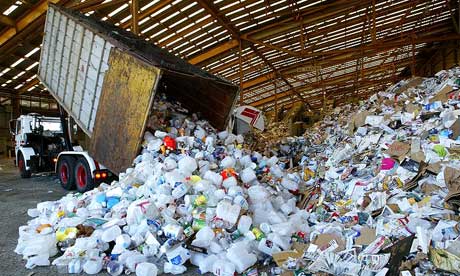
In the UK, local councils have been forced by national government to recycle more waste, both directly and indirectly via a landfill tax.
But does anyone know just how effectively this will reduce our carbon footprint?
That is not a rhetorical question readers. If you know or suspect an approximation of an answer, or a partial one, please post a comment.
Some of the questions that need answering include the energy consumption involved in collecting and sorting recyclable waste and the overall energy savings in the re-manufacture of the materials, which may involve shipping materials half way around the globe. And on that last point, how much of the stuff simply ends up in a third-world landfill?
Some of the questions that need answering include the energy consumption involved in collecting and sorting recyclable waste and the overall energy savings in the re-manufacture of the materials, which may involve shipping materials half way around the globe. And on that last point, how much of the stuff simply ends up in a third-world landfill?
Friday, 11 January 2008
Heads in the Sand
Has it really been six months since I last posted here?
I have been really busy lately, writing training manuals, answering queries from fellow cleaners and in between running my carpet and upholstery cleaning business. I have also been getting increasingly annoyed at hearing comments like "Me recycling a few bottles is not going to save the planet".
How can people be so blinkered?
It's not about saving the planet. Planet Earth will survive the current trend of climate change. It has survived far worse in the past - including the cataclysmic event that lead to the extinction of the dinosaurs, a few ice ages and sundry other major upheavals.
Whether the undeniable changes that we are currently seeing are part of a natural cycle or not, we do, at least partly, understand the mechanism of change. We do know approximately the quantities of greenhouse gasses that human activity is contributing, and logic dictates that whether that contribution is a causal or contributory factor, continued pollution at the same level is not the wisest course.
There are vested interests commissioning misinformation about what is happening and the probable prognosis. Yet even if the propaganda of the 'Just keep burning that oil' lobby is partially correct the inescapable truth is that the effects of the changes are already upon us. As sea levels rise the threat to low-lying land massed increases, threatening a reduction in the inhabitable and food production areas. At the same time human populations expand - the world population has about doubled in my life-time. The demands for food and living space will become increasingly difficult to satisfy. Perhaps we could turn to the seas to satisfy some of the increasing demand for food but increased atmospheric carbon dioxide levels is leading to raised oceanic acidification, the impact of which is already being seen on marine life.
So "......recycling a few bottles" is not needed to save the planet. nor will the best efforts of an individual will not halt nor reverse the changes that are already all too obvious. But cumulatively the efforts of many cannot fail to at least slow the progress.
A wise man once said that when finding yourself in a hole where you do not want to be, the first thing to do is to stop digging!
I have been really busy lately, writing training manuals, answering queries from fellow cleaners and in between running my carpet and upholstery cleaning business. I have also been getting increasingly annoyed at hearing comments like "Me recycling a few bottles is not going to save the planet".
How can people be so blinkered?
It's not about saving the planet. Planet Earth will survive the current trend of climate change. It has survived far worse in the past - including the cataclysmic event that lead to the extinction of the dinosaurs, a few ice ages and sundry other major upheavals.
Whether the undeniable changes that we are currently seeing are part of a natural cycle or not, we do, at least partly, understand the mechanism of change. We do know approximately the quantities of greenhouse gasses that human activity is contributing, and logic dictates that whether that contribution is a causal or contributory factor, continued pollution at the same level is not the wisest course.
There are vested interests commissioning misinformation about what is happening and the probable prognosis. Yet even if the propaganda of the 'Just keep burning that oil' lobby is partially correct the inescapable truth is that the effects of the changes are already upon us. As sea levels rise the threat to low-lying land massed increases, threatening a reduction in the inhabitable and food production areas. At the same time human populations expand - the world population has about doubled in my life-time. The demands for food and living space will become increasingly difficult to satisfy. Perhaps we could turn to the seas to satisfy some of the increasing demand for food but increased atmospheric carbon dioxide levels is leading to raised oceanic acidification, the impact of which is already being seen on marine life.
So "......recycling a few bottles" is not needed to save the planet. nor will the best efforts of an individual will not halt nor reverse the changes that are already all too obvious. But cumulatively the efforts of many cannot fail to at least slow the progress.
A wise man once said that when finding yourself in a hole where you do not want to be, the first thing to do is to stop digging!
Saturday, 30 June 2007
How green is green?
"Going Green" is not always as strait forward as you might think!
One alternative to those nasty petroleum-based fuels are the emerging range of 'Biofuels'. Based on plant materials, these are said to be a greener option than fossil fuels.
But just how green are they?
In parts of the world natural rain forest is being cleared (slashed and burned) for the production of oil palms, a prime source of biofuel.
Unfortunately, not only does the clearance release massive amounts of carbon dioxide and destroy the habitat but the soil that has supported lush rain forest for so many years will become impoverished in (at the most) twenty years of this 'unnatural' use. When it is abandoned as useless for this crop it will no longer be able to support the natural vegetation.
.............Maybe the forest is greener than the fuel!
How Green is green?
"Going Green" is not always as strait forward as you might think!
One alternative to those nasty petroleum-based fuels are the emerging
range of 'Biofuels'.
Based on plant materials, these are said to be a greener option than
fossil fuels.
But just how green are they?
In parts of the world natural rain forest is being cleared (slashed and
burned) for the production of oil palms, a prime source of biofuel.
Unfortunately, not only does the clearance release massive amounts of
carbon dioxide and destroy the habitat but the soil that has supported
lush rain forest for so many years will become impoverished in (at the
most) twenty years of this 'unnatural' use. When it is abandoned as
useless for this crop it will no longer be able to support the natural
vegetation.
One alternative to those nasty petroleum-based fuels are the emerging
range of 'Biofuels'.
Based on plant materials, these are said to be a greener option than
fossil fuels.
But just how green are they?
In parts of the world natural rain forest is being cleared (slashed and
burned) for the production of oil palms, a prime source of biofuel.
Unfortunately, not only does the clearance release massive amounts of
carbon dioxide and destroy the habitat but the soil that has supported
lush rain forest for so many years will become impoverished in (at the
most) twenty years of this 'unnatural' use. When it is abandoned as
useless for this crop it will no longer be able to support the natural
vegetation.
.............................Maybe the forest is greener than the fuel!
Tuesday, 5 June 2007
Eco-Friendly Carpet Cleaning Professionals
Thanks to growing awareness about the potential health impacts of carpet cleaning, a new breed of professional services has sprung up that avoids dangerous and polluting chemicals in favour of more natural solutions. Leading the move to newer, 'greener', more eco-friendly cleaning solutions used by professional services is the plant based M-Power, the carpet and upholstery super-concentrate that out-performs the 'nasties' by an appreciable margin.
The health benefits for the cleaner, the customer and the planet, perhaps surprisingly, come without additional cost - indeed considerable savings can be made by its use.
Most carpet cleaning services are local businesses, and many have greened-up their processes in recent years and are reaping the rewards as environmentally-aware consumers in their area are seeking out more the more responsible routes to take in the conduct of their lives. If you need your carpets cleaned you should call around and ask questions. If a service provider doesn’t know the environmental impact of that service, they should probably be avoided.
I, for one do not care what motivates a business to walk a greener path, be it genuine concern for the planet, its current and future occupants or just that it is good for their business. The environmental gains will be the same as long as the greening is not just a re-badging exercise.
The health benefits for the cleaner, the customer and the planet, perhaps surprisingly, come without additional cost - indeed considerable savings can be made by its use.
Most carpet cleaning services are local businesses, and many have greened-up their processes in recent years and are reaping the rewards as environmentally-aware consumers in their area are seeking out more the more responsible routes to take in the conduct of their lives. If you need your carpets cleaned you should call around and ask questions. If a service provider doesn’t know the environmental impact of that service, they should probably be avoided.
I, for one do not care what motivates a business to walk a greener path, be it genuine concern for the planet, its current and future occupants or just that it is good for their business. The environmental gains will be the same as long as the greening is not just a re-badging exercise.
Tuesday, 1 May 2007
A slight detour - and some very long journeys
Wandering briefly off the topic of cleaning but still on concern for our planet........................
I was in an English supermarket last weekend and saw some rather appetising-looking strawberries. The label said that they were from New Zealand! Now I have absolutely nothing against that country but what do you suppose is the carbon cost of flying each punnet of strawberries from the other side of the planet? Do we really need to buy out-of-season produce if the environmental cost is so high?
Perhaps even more disturbing is the amount of lamb which is imported by the UK from New Zealand, whilst we are exporting many tons of home-grown lamb to Europe and elsewhere. Remember also that much of the transportation is under refrigeration, which in itself greatly increases the carbon cost of the exercise.
Just two examples of unnecessary and wasteful 'food miles'. It is in the hands of the consumer to bring sanity to this insane situation - but do enough consumers care? At least if those who do already care help educate the populace as a whole as to what is occurring and the potential consequences, maybe there is hope that a significant number will examine their lifestyles from an ecological standpoint and perhaps mend their ways.
"Seeking a better way" - World of Clean
I was in an English supermarket last weekend and saw some rather appetising-looking strawberries. The label said that they were from New Zealand! Now I have absolutely nothing against that country but what do you suppose is the carbon cost of flying each punnet of strawberries from the other side of the planet? Do we really need to buy out-of-season produce if the environmental cost is so high?
Perhaps even more disturbing is the amount of lamb which is imported by the UK from New Zealand, whilst we are exporting many tons of home-grown lamb to Europe and elsewhere. Remember also that much of the transportation is under refrigeration, which in itself greatly increases the carbon cost of the exercise.
Just two examples of unnecessary and wasteful 'food miles'. It is in the hands of the consumer to bring sanity to this insane situation - but do enough consumers care? At least if those who do already care help educate the populace as a whole as to what is occurring and the potential consequences, maybe there is hope that a significant number will examine their lifestyles from an ecological standpoint and perhaps mend their ways.
"Seeking a better way" - World of Clean
Sunday, 15 April 2007
Five months on..........
M-Power has been embraced by the UK professional cleaning community as a highly effective cleaning agent. Uptake has been from a broad spectrum of carpet and upholstery cleaners but especially those with a particular interest in eco-friendly cleaning.
Every effort has been made at all stages of production, distribution and end use to reduce its carbon footprint. But perhaps its greatest impact is due to the fact that it not only enables highly efficient cleaning to be performed with reduced use of water but also that it does so without the need for that water to be heated.
The carbon cost of each gallon of water we use is far higher than many appreciate. That cost arises not so much from the processing of water but the vast amounts of electrical energy consumed in pumping water around the country.
I am soon to become a grandfather for the first time. I would like to think that the world that my grandchildren - and their children - inherit has been as little damaged as possible by my actions. There is still a great deal of scepticism about the causes of global warming. Maybe I am misguided in my belief that man has at the very least made a contribution to the phenomenon but if so actions being taken to reduce carbon emissions can do no harm.......... On the other hand, if the assumption is correct, then failing to act now could have catastrophic consequences in the not-so-distant future,
Every effort has been made at all stages of production, distribution and end use to reduce its carbon footprint. But perhaps its greatest impact is due to the fact that it not only enables highly efficient cleaning to be performed with reduced use of water but also that it does so without the need for that water to be heated.
The carbon cost of each gallon of water we use is far higher than many appreciate. That cost arises not so much from the processing of water but the vast amounts of electrical energy consumed in pumping water around the country.
I am soon to become a grandfather for the first time. I would like to think that the world that my grandchildren - and their children - inherit has been as little damaged as possible by my actions. There is still a great deal of scepticism about the causes of global warming. Maybe I am misguided in my belief that man has at the very least made a contribution to the phenomenon but if so actions being taken to reduce carbon emissions can do no harm.......... On the other hand, if the assumption is correct, then failing to act now could have catastrophic consequences in the not-so-distant future,
Thursday, 23 November 2006
The Future of Cleaning

Solution UK Ltd. are delighted to announce the official launch of M-Power® Carpet Cleaner, the next generation in nanotechnology cleaning agents, which meets or exceeds all currently known domestic and international regulatory standards. It is therefore one of the “greenest” cleaning solutions available with today’s technology.
M-Power® has been tested to ensure that all compounds that are considered hazardous and toxic to the operator and the environment, by domestic and international regulatory agencies are not present in this unique formulation.
This is the first of a new line of advanced nanotechnological cleaning products in the M-Power® range, which has been produced following extensive research and development by Solution UK Ltd.
Developed and manufactured here in the UK, the M-Power® range uses powerful natural-molecular technology combined with advanced biotechnology techniques. The result of this new technology is an amazing range of environmentally friendly and biologically active cleaning solutions, which clean without compromising performance or safety.
M-Power® Carpet Cleaner uses natural-molecular technology to provide a bio-surfactant that is completely non-toxic, is totally safe to handle and cleans with superb results.
Derived from renewable sources, M-Power® Carpet Cleaner is safe to use, store and dispose of. This unique product dilutes at an unbelievable 1:120 for normal carpet and upholstery cleaning and provides a solution for environmentally aware companies and customers who appreciate and understand the need to use non-toxic, eco-friendly solutions in the cleaning process.
M-Power® Carpet Cleaner, is
This is the first of a new line of advanced nanotechnological cleaning products in the M-Power® range, which has been produced following extensive research and development by Solution UK Ltd.
Developed and manufactured here in the UK, the M-Power® range uses powerful natural-molecular technology combined with advanced biotechnology techniques. The result of this new technology is an amazing range of environmentally friendly and biologically active cleaning solutions, which clean without compromising performance or safety.
M-Power® Carpet Cleaner uses natural-molecular technology to provide a bio-surfactant that is completely non-toxic, is totally safe to handle and cleans with superb results.
Derived from renewable sources, M-Power® Carpet Cleaner is safe to use, store and dispose of. This unique product dilutes at an unbelievable 1:120 for normal carpet and upholstery cleaning and provides a solution for environmentally aware companies and customers who appreciate and understand the need to use non-toxic, eco-friendly solutions in the cleaning process.
Manufactured from 100% natural plant based materials
M-Power® Carpet Cleaner, is
- Derived from renewable/sustainable sources
- Fully Biodegradable
- Exhibits anti-bacterial & anti-viral properties thanks to its unique natural-molecular cleaning action.
- Non-toxic to humans and pets
- Non-toxic to aquatic life
- Non-reactive with chemicals, such as chlorine bleach
- Non-caustic
- Non-combustible
- Non-corrosive
- Non-flammable
- Non-fuming,
- Non-hazardous
- Non-polluting
- NO ammonia
- NO animal products
- NO Bacteria or Enzymes
- NO artificial ingredients
- NO isopropyl alcohol
- NO phosphates
- NO solvents (apart from water)
- NO synthetic chemicals
- NO harmful ingredients
- NO Soap or detergents
When used at the recommended 1:120 dilution, M-Power® Carpet Cleaner’s cost will be less than 1p (one penny!!) per square metre of carpeting cleaned.
Have a care for our planet - M-Power is designed to be environmentally responsible in raw material usage, production, transportation, potential methods of employment, right through to the composition and biodegradability of the eventual waste.
Profligate release of carbon into our atmosphere cannot be sustained at current levels. Nor can we continue to pollute our soils and our water as we have been doing. As the human population of our home planet grows at an alarming pace the pressures on its natural resources increases and its ability to self-heal is pushed to (or maybe beyond) the limit.
The use of responsible cleaning products and methods may not have a major impact on the planets future but with a problem of this enormity and complexity, we must each do what we can in our individual areas of influence. We cannot leave the solution to the worlds governments to tackle the problem - we must give them the political will to act whilst not abdicating our personal responsibility to future generations.For more Eco-friendly solutions see World of Clean
Subscribe to:
Posts (Atom)


